Additional
contents

Natural capital: for sugarcane cultivation, we depend on favorable weather conditions, soil with nutrients for crop development and water.
Manufactured capital: we produce VHP (Very High Polarization) sugar, ethanol and electricity in state-of-the-art industrial facilities.
Human capital: our members are the driving force for business development in line with our values, ethics, transparency and integrity.
Intellectual capital: in order to ensure the productivity and quality of our agricultural and industrial operations, we invest and strive for the best use of technology and innovation.
Social and relationship capital: in addition to the indirect economic impact of our operations, we have built initiatives and actions that encourage the development of communities in the municipalities where we operate.
Financial capital: the commercialization of the products and the trust of our clients, together with the operations carried out with the financial institutions, promote revenue generation and resource allocation according to the investment pipeline.
Our Materiality Matrix was revisited in 2018 to further reflect our impacts, risks and opportunities, as well as meet the expectations of our audiences. As a result of this process, 11 themes were considered material, of which three are priority and eight very important.
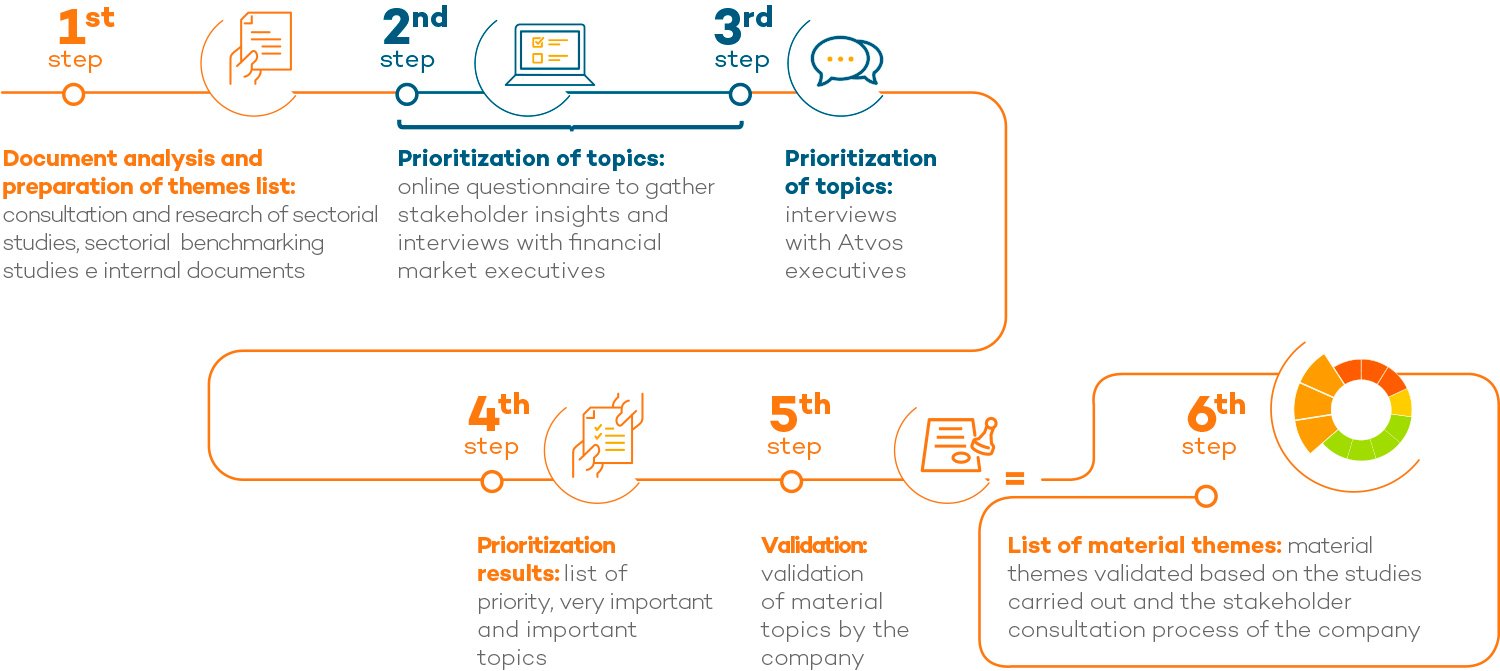
The review process for our Materiality Matrix during the harvest considered the Global Reporting Initiative (GRI) guidelines as well as the assumptions of the International Integrated Reporting Council (IIRC). The process included the following steps:
In the first step, a list of 24 themes was drawn up based on consultation with Atvos' annual report and the materiality process from the previous year, the Dow Jones Sustainability Index (DJSI), the New York Stock Exchange and the Corporate Sustainability Index (ISE, in Portuguese) questionnaires of B3 S.A. – Brasil, Bolsa, Balcão (B3), in addition to internal documents and external materials, such as the Sustainability Accounting Standards Board (SASB) – Agricultural Products and SASB Biofuels, The Sustainability Yearbook 2018, by RobecoSAM (company operating globally in the sustainability investment sector), a guide for Bonsucro and sector documents and benchmarks. The themes raised are current for the sugar-energy sector and for the future demands of society.
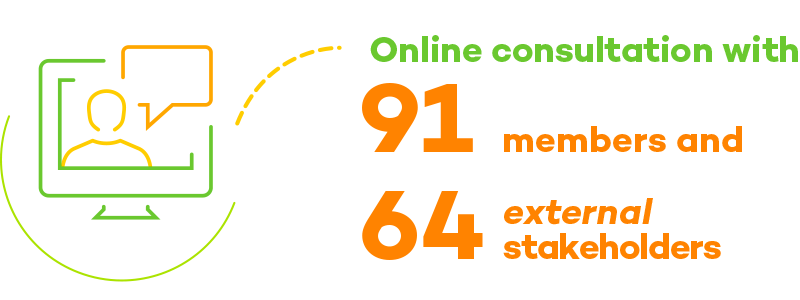
In the prioritization phases (steps 2, 3 and 4), an online consultation was conducted with 91 members and an interview was made with ten company executives. Through an online research we externally surveyed 64 stakeholders – agricultural partners, suppliers, the financial market, customers, civil society, the press, development banks, class entities and government representatives – and conducted interviews with six financial market executives.
In the validation phase (steps 5 and 6), the top 11 themes considered material for Atvos were validated by senior management from the perspective of our stakeholders. The steps can be verified below.
Material themes and limits | ||||||
Capitals | Relevance | Material theme | GRI Topic | GRI Standards | Impact inside Atvos | Impact outside Atvos |
Intellectual/ | 1st | Productivity and technology in the field and industry | Yes | Agricultural | ||
3rd | Debt level | Yes | Investors, lenders, suppliers, agricultural partners and customers | |||
Social and | 2nd | Ethical, fair and transparent | Ethics and integrity/Anti-corruption | 102-16, 102-17, | Yes | Agricultural |
4th | Guarantee of human and labor rights | Freedom of association and collective bargaining/Child labor/Forced or slave-like labor/Rights of indigenous and traditional peoples/Human rights assessment | 408-1, | Yes | Communities | |
5th | Health and safety | Occupational health and safety/Safety practices | 403-1, 403-2, | Yes | ||
6th | Training and appreciation | Employment/Training and education/Non-discrimination/Freedom of association and collective bargaining | 401-1, 404-1 | Yes | ||
7th | Relationship and | Supplier environmental assessment/Supplier social assessment | 308-1, 308-2, | Yes | Agricultural | |
Natural | 8th | Clean energy and | Energy | 302-1 | Yes | Customers and society |
9th | Controls and prevention | Materials/Energy/Water/Biodiversity/Emissions/Effluents and waste/Environmental compliance/Supplier environmental assessment | 301-1, 302-1, | Yes | Society, customers, | |
10th | Responsible land use | Effluents and waste | 306-2, 306-3 | Yes | Community and society | |
| 11th | Water management | Water | 303-1 and 303-3 | Yes | Community and society |